Interpreting Nonconscious Data | New eBook from L&E

The market research industry is approaching an alarming crossroads. On one hand, DIY tools like SurveyMonkey and Google Consumer Surveys are taking off, making it possible for anyone to create their own survey for free. Research firms are left vying for work on more complex studies that require their expertise and scale, and client-side researchers are equally challenged, as budgets dry up and internal clients expect insights that are faster, cheaper and actionable.

At the same time, there is also a growing consensus that consumers cannot always accurately tell market researchers what we want to know; that consumers are highly emotional and make decisions for reasons that are often not accessible to their consciousness (and, by extension, not discernible through classic market research techniques).

Amidst this disruption, the utilization of nonconscious measurement (also called “neuromarketing” or “applied neuroscience”) for commercial research continues to be a growing trend for pursuing consumer insights.

To continue reading, get our latest eBook by clicking here (no form to fill out), Interpreting Nonconscious Data, written by Leonard Murphy, Editor-in-Chief of GreenBook.

L&E Webinar | The Participation Game: How & Why Millennial Consumers Adopt Brands

Digital connectivity has changed the way we interact with one another – people no longer want to consume marketing, they want to participate in brands. To connect with people, brands must first develop a true understanding of how they interact with the world around them. The key for marketers is then engaging with people the way that they interact naturally: ceasing to market to consumers and instead inviting people to participate in the brand.

On Friday, October 21 at 1:15 pm (ET), L&E hosted a webinar with guest speaker Norty Cohen, CEO and founder of Moosylvania. This webinar featureed highlights from a four-year study that agency Moosylvania has conducted. Norty took partipants through key insights on how and why Millennial consumers adopt brands.

About Moosylvania

Moosylvania’s mission is to truly understand how and why Millennial consumers adopt brands. By modeling how people interact digitally (with everyone from their friends to entertainment to services they rely on), they are able to connect brands with people in a world that changes every day. Their unique toolset – including original branding, digital and experiential programming – is designed to support an approach that results in genuine brand participation. Learn more at www.moosylvania.com.

Qualitative Research: Adapting with the Needs of Researchers

Qualitative research is a set of methodologies whose common goal is to explore and uncover the hows and whys of consumer behavior. It’s left to quantitative research to measure the “how much”. The categories of qualitative and quantitative have been easy monikers to differentiate the concepts of exploration compared to confirmation, depth of insight compared to breadth of insight, the immeasurable contrasted to the measurable. 

But the lines between qualitative and quantitative are blurring rapidly. While there are numerous reasons for this, two of the main forces are business demands (speed, cost and acting on useful information) and the capabilities afforded by technology.

Business Demands

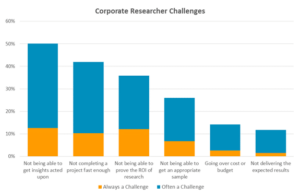
When corporate researchers were asked about their pain points for the 2016 Quirk’s Corporate Researcher Report – too many projects for staff or budget topped the list as always or often a pain point (60%, 50% respectively). When asked about challenges – corporate researchers noted the inability to for insights to drive action and not being able to complete projects fast enough as always or often a challenge (50%, 42% respectively).

When looking at the newer methods of research, corporate researchers view qualitative tools (as a whole) as more effective at providing actionable insights. “Online qualitative/focus groups” are viewed by 70% of corporate researchers as effective or very effective. Mobile-specific surveys are second (53%). But the next couple are also qualitative techniques – social media research (40%) and text analytics (52%).

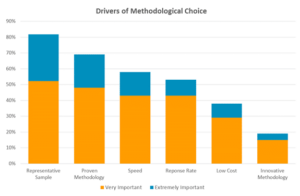
Taking the premise that actionable insights are the number one goal for corporate researchers and the number one challenge, and that qualitative research (at least among the newer methods) generally does a better job of providing these insights, then it is likely that more energy will be directed here. At the same time, there is a methodological drag to qualitative research according to this survey. The top four drivers of methodological choice for a project are; representative sample (82% viewed as very or extremely important), proven methodology (69%), speed (58%), and response rate (52%).

While qualitative has never been about representation per se, the scale in some tools is pushing that of quantitative. Some of the newer qualitative tools do have a good way to go before they are as deemed worthy of a wide variety of use cases – but that is changing rapidly.

Technological Capabilities

Technology is changing the nature of qualitative in several different ways:

  • Scale:  We currently have some qualitative information at the scale of quantitative – and a growing ability to analyze that information. The easiest examples are both based in text analytics – customer service information and social media analytics are able to provide some structure to the vast amounts of unstructured data available in their respective data sources. While there are limitations; sample management, response bias, etc., those only limit some applications. The variety of proven use cases continues to grow, expanding into consumer needs, brand management, operations, and more.
  • Geography:  As the tools a respondent needs to participate in qualitative research sit in the purse, pocket, or on the kitchen table, geography is much less of an issue than it was before. Many of the corporate researchers that are using newer methods, such as online qualitative, mobile ethnography, etc. are doing so to take advantage of the access to consumers in the appropriate environment. Mobile, in particular, has the benefit of providing “in the moment” access in the way that was almost cost prohibitive using other tools – particularly low incidence or sensitive topics.
  • Cost: The “somewhat” lower cost of qualitative methods is also seen as a reason for switching.  Several researchers mentioned the cost of online qualitative and communities as reasons for moving away from more traditional qualitative methods.  This was generally expressed in terms of travel cost, but occasionally as overall project cost. Though it was not mentioned, social media analytics can be very cost effective depending on the type and frequency of projects.
  • Depth of Insight: Deeper information is available through communities than through other traditional methods. This is a driver of choice for a few researchers that noted the ongoing nature of a community allows a more longitudinal look at consumers and their product issues.
  • Speed: Speed is one of the top two corporate researcher challenges. While technology has improved speed to insight in almost all the tools mentioned to this point – it is hit and miss.  Once a social media program or community is up and running, the speed to insight is generally improved over traditional methods.  But according to one researcher, online qualitative groups are “not a lot faster”.  However, the future holds a different story.

The Future of Qualitative Research

Recent advancements signal the future of qualitative research. Text analytics improve month by month. Several companies have had different levels of success in identifying emotional context, purchase probabilities, consumer values, and a number of other frameworks that build on our understanding of consumers and their relationship to our products. Other qualitative methodologies have automated processes for understanding the emotional connections consumers develop with products and brands through imagery, metaphors, and other projective techniques. Crowd-sourcing has been in use for several years, but new applications and technologies are able to provide deep understanding of an issue in a cost-effective and timely manner – and at the scale of quantitative research. Artificial intelligence is making its way into marketing research. These tools have been around for a couple of years, but have improved dramatically in the past year. Many of these tools measure delivery in hours or days instead of weeks or months.

In addition, we should start to see the synthesis of mobile sensors, shopping or purchase behavior, and advertising effectiveness over the next year. This puts the depth of qualitative insights in context with behaviors – which is the holy grail of market research.

The future of qualitative research addresses the key pain points of today’s corporate researcher. The lower cost provided by technology and improved user interface will reduce the impact of constrained resources. Technology is also quickly and significantly improving the time to insights. Experience will prove the application to specific use cases. Scale will reduce the concern about sample representation. And most importantly, the quality of insights provided by new qualitative methods has and will continue to improve  Many of the newer methods are combining the depth of qualitative with the breadth of quantitative – getting us to the how, the why, AND the “how much”.

This article first appeared in the 2016 Quirk’s Corporate Researcher Report.

Webinar Recording | The What, When, Why & How of Unobtrusive Observation

Ethnographic market research aims to understand the consumer in her natural environment. Typical ethnographic research requires a skilled interviewer to conduct the research onsite or in the respondent’s home, but a growing trend in market research is to employ a technique known as Unobtrusive Observation, in which the ethnography takes place without the interviewer present. This method allows respondents to act naturally, uncovering deep insights into the motivational drivers of those behaviors.

On August 19, 2016, L&E hosted a webinar, The What, When, Why & How of Unobtrusive Observation, with guest speakers Abbe Macbeth, PhD and Jason Rogers, PhD of Noldus Information Technology. The webinar provides a practical guide through the unobtrusive observation ethnography process. This session is for both those new to observational research, and those well-seasoned in traditional ethnographies.

This session covers:

  • A comparison of unobtrusive observation and traditional methods (ethnography, focus groups)
  • An overview of observational research in consumer behavior
  • Research logistics: cameras, coding, and consequences
  • Examples and stories from past research

Webinar Presentation

Click here to download a PDF copy of the presentation from the webinar.

Webinar Recording

About Abbe Macbeth, PhD
Abbe Macbeth, PhD is a Regional Sales Manager for Noldus Information Technology. Taking her expertise in Behavioral Neuroscience into scientific sales in 2010, Abbe set multiple company records for sales within the first two years. Quickly moving into a managerial role, she is now responsible for overseeing four sales regions and Noldus Consulting Services, US. Abbe is passionate about behavioral research in all forms, and delights in helping others find the perfect solution to meet their needs. Abbe holds a Bachlors degree in Cognitive Science, a Master’s degree in Psychology, and a PhD in Behavioral Neuroscience from City University of New York.
About Jason Rogers, PhD
Originally from Indiana, Jason received his doctorate in Psychology from the University of Utah. After a fellowship at MUSC in Charleston, SC, Jason joined Noldus in 2008 as Product Expert and Lead Trainer. Jason also spent time as a Consultant with Nielsen Consumer Neuroscience and Science Officer at Brandtrust before returning to Noldus in 2013 as Midwest Accounts Manager and Senior Consultant. Jason has done hundreds of lectures, trainings, and workshops around the globe. Jason lives in Cincinnati and spends his free time running, biking, playing the drums, and keeping up with this significant other, daughter, and sheepdog.

Why Focus Groups are Thriving in a Digital World

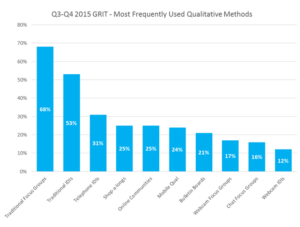
Recently, technology has given marketers many new and innovative ways to tap in the customer psyche and create a stronger, more visceral understanding of the marketplace. And while these new market research tools have great promise, none has yet taken the place of the traditional focus groups in delivering valuable insight. As shown in the 2015 Greenbook Research Industry Trends (GRIT) report, 79% of respondents reported using qualitative research in the previous year – and traditional focus groups maintain their position as the most used qualitative methodology. In total, 68% of 2015 GRIT respondents reported using traditional, face-to-face focus groups, up from 59% in 2014.
 

To be sure, periodically some “expert” declares focus groups dead – or at least dying – and advocates for their removal from the marketing research tool kit. And just as inevitably, marketers continue to ignore these so-called “experts” and use focus groups to develop stunning and exciting customer insights that deliver business success and profits.

The Internet, social media, digital technologies, video and graphics – all of these trends have changed the way we communicate and conduct business with each other. We now expect things to happen faster, more creatively and more efficiently than ever. And those expectations of speed, collaboration, creativity and flexibility are now requirements in all of our interactions with each other, personally as well as in our business and commercial interactions.

Not surprisingly, those changes in the way we need to interact with each other have also impacted the way marketers interact within their teams and how they expect to use information in managing brands, products and services. Ironically, the traditional focus group (or dyad or triad) is ideal at delivering the environment demanded by today’s marketers: offering greater speed, creativity, flexibility and collaboration than many other marketing research techniques.

COLLABORATIVE CREATIVITY

Great marketing is the art of making connections and building relationships – between products and customers, between services and customers, and between brands and customers. In the most natural sense, focus groups deliver the setting and inquiry that leads to the creation of and the understanding of these fundamental relationships.

Focus groups maximize all available brainpower (yours, the consumer’s and the moderator’s) by bringing it together in a tightly defined opportunity for discussion and brainstorming. While you may begin the focus group process with one objective, you can allow consumer insight be developed ad hoc by following the discussion and commentary in the group. Indeed, technology in focus groups has delivered new ways to stimulate consumer thinking and to advance the discussion agenda, such as usability testing and other kinds of collaborative tools for marking up communications and brainstorming new product features.

CUSTOMER INTIMACY

There is great power in watching a focus group. You look your customer in the eye, you see their body language, you get a strong sense of their emotions. You can watch them feel, touch, and use your products. You can watch their reactions to your carefully crafted messages. And when the focus group participants speak, they are speaking directly to you.

And that communication can go well beyond the marketing team. Product research and design, engineering, operations – no matter your role in product development and delivery, you cannot attend a focus group without hearing the voice of the customer. Focus group respondents pronounce judgments that influence the path and development of the product or service and impact its eventual success. And those product evaluations are all the more effective because of the intimate and personal nature of the focus group environment.

SPEED

All marketers continually fight the time challenge: you have less time to do the work, less time to launch the product, less time to prove the product works or not. Consumers today demand ever-changing and ever-evolving products and services. Many marketers simply do not have the time necessary for quantitative research. And they certainly don’t have the time necessary for quantitative research that might or might not deliver game-changing information.

Well-designed, well-recruited and well moderated focus groups can deliver key insights in a nanosecond. As one marketing manager told us, “You walk into the groups scratching your head, and you walk out with answers and direction.”

FLEXIBILITY

An obvious advantage to focus groups is that you do not get to the end of the project before you realize you’ve been asking the wrong questions. Because focus groups can take an iterative approach, the questions asked in the beginning define the questions to be asked later on in the groups. If you do not know the answer, you may not even know to ask the question. Focus groups give you the chance to define the question while you are getting the answer.

FOCUS GROUPS: A Perennial Favorite for Marketers

The stakes are high for marketers and market researchers alike these days. With increasing pressure on market research budgets, each project is required to provide critical insight for business success. The risk of non-delivery is high with many of the techniques available to market researchers, for the new and innovative techniques as well as for the “tried and true” techniques. And that is why focus groups continue to be so popular. As reported in Quirk’s 2015 Corporate Research Report, corporate purchasing of focus group facility and moderating services has held tight for nearly a decade, including during the 2008 economic downturn. Clearly, focus groups offer marketers an enduring value that supports their decision making.

Focus groups have many of the particular characteristics that marketers are looking for: They quickly deliver immediately useful insight and information. They are compelling and personal, producing results that drive change in behavior and direction. They are flexible and facilitate collaboration and creativity. In short, focus groups have the ability to ignite business success.

So, while they are not new or different, it is no wonder that focus groups remain a perennial favorite for marketers – and will continue as such for years to come.


Better Together: Using Qualitative Research for Better Quantitative Research

Recently, L&E Research hosted a webinar with guest speaker David F. Harris, Founder of Insight & Measurement. David is the author of, The Complete Guide to Writing Questionnaires: How to Get Better Information for Better Decisions.

(Click here to view the recording of David’s Webinar.)

David wrote his book to address the following concerns about market research and questionnaires:

  • Research is rarely organized to support decision making
  • Often, no qualitative research is conducted prior to questionnaire development
  • Questions are often unclear, biased, or not answerable by the respondent
  • Questionnaire pretesting is not practiced widely enough

Questionnaire writing is serious business and is as much art as science. Most researchers have struggled with questionnaire design, recognizing that understanding how consumers think about a topic, as well as science, logic, reasoning and sound research practice, are all necessary to producing a good questionnaire.

Qualitative research is often skipped in the questionnaire development process, to the detriment of question quality. David recommends a research framework that includes two points of qualitative research to inform and improve questionnaire development:

Before You Plan the Questionnaire

First, qualitative research should be conducted before the questionnaire planning begins. Conducting a focus group or several in-depth interviews will let you hear the words and phrases the consumer uses in discussing the product or the purchase experience, understand the logical sequence of topics for the consumer, and identify the correct metrics to use in your questions. Let’s say you are conducting a survey about children’s studying habits. You think children study outside of the classroom between two and five hours per day, six days a week. In your qualitative research you find the norm is actually 30 minutes to two-and-a-half hours, five days a week. If you had based your question on your assumption, you might have used the wrong scale in your quantitative research, leading respondents to overstate their studying habits and for bad decisions to be made based on this information.

Hopefully, it goes without saying you must do the qualitative research with the same pool of respondents who will be completing the quantitative research. You can’t just ask your coworkers to help you out with this!

Pretest (and Revise!) the Questionnaire

Even if you conduct qualitative research before you plan your questionnaire, David recommends conducting qualitative research a second time, just before the quantitative data collection begins. The only way to truly test whether a question works is to have a real respondent try to answer it. David suggests a two part pretest – First, ask internal resources to review your questions, find problems, and make improvements. Second, pretest the questionnaire with real respondents, ensuring that you administer the questionnaire pretest to a sample of each segment of respondents. Bring these respondents – and again, real respondents – into a focus group facility and ask them to complete the survey using the phone, online, or whatever methodology you will use in the actual research.

After each respondent has completed the survey, go through it with them question by question. Did they have any uncertainty about what was being asked or how to answer? Was any wording vague or unfamiliar? When they were unsure about what was being asked, how did they decide upon an answer? For example, if your question asks about cars owned by the respondent, does that include trucks? Would “vehicles” be a better word choice? What if you lease your vehicle – does that count? Qualitative research can help you make sure the information you get from your questionnaire is the information you need to have.

As you consider implementing these suggestions into quantitative research project, you may encounter objections that it will take too long, cost too much, or that you already know about your customers. In spite of these objections, researchers must take responsibility for asking the best questions possible. Think of qualitative research as an insurance policy on your results; it may be very cost effective in the long run. After all how long will it take and how much will it cost to recover from a poor business decision?

Want more advice on writing better questionnaires? Check out David’s website –www.davidfharris.com or watch one of his previous workshop videos on our webinars page.

The Potential of Technology and Observational Research


Can you observe the future?  What about the past?  Can you observe something you haven’t seen?  Watching a movie or reading a book can let our brain contemplate these issues – but not experience it.  So until recently, the answer has been mostly ‘no’.  Observation has always been about what is happening now, and other qualitative techniques have been about “what would you do if….”.

There are two key developments in technology that have changed the “practical observable universe” – in both number and content – and will continue to do so.  With over 2 billion of the 7.4 billion people on Earth on smartphones and social media – over a quarter of the world’s population is now in this practical observable universe.  The “smartphone” requirement is used to narrow the population, not to limit to a particular tool – though it is the most important one.  Traditional ethnography has allowed us to see only 20 people, or 50, or 100.

The passive role of our digital footprint allows us to share a lot of information with a lot of different companies.  We share this information in ways that we don’t often think about – but to which we actively agree – by hitting the “Accept” button, or using sensors, or having a wearable device, or using eye/fingerprint scanning.  This information can tell where you are or have been, how you’re feeling, what you watched on TV or listened to in your car, what and who you care about, what you shopped for and bought, and what you thought about and then read about online.  Amazing information.  When you add this information to the more active role of mobile ethnography or qualitative – the depth of information can be as impressive as the breadth.  Several industries, other than the spy industry, are doing a good job of utilizing this information.  Healthcare uses social media analytics and geo-targeting to identify and manage potential pandemics.  The automotive industry is using the Internet of Things and sensors to understand driving styles and personal needs to adapt the time commuting to home more efficiently.  These are just a few small examples.

The observable has always been in the present – but not anymore. Virtual reality allows us to experience non-existent situations – and what we would do in those situations – in a way that makes them feel very real.  This technology allows us to create situations to understand consumer behavior in a “what if” manner.  Projective techniques have often been used for this in a qualitative setting.  Virtual reality is the mother of all projective techniques.  Now that the headsets work with most popular smartphones and you can purchase them for $2 (I just checked Amazon) – their integration into marketing research is on its way to being ubiquitous.  And the use cases – from advertising to product concepts to store layouts – are primed.

The “practical observable universe” is larger now than ever.  One concern for learning from this universe is that our industry has lagged many in adopting new technologies (e.g., we still have methodological discussions about adapting to mobile as a data-collection channel).  And aggregating and using the data is still a challenge as the “Wal-Mart” of data still doesn’t exist – but it can be found, created, and used. The effort is time-consuming – but the benefits can be enormous.

L&E Webinar Recording | How to Write Better Screeners to Get the Right Respondents

Take the time and struggle out of writing screeners and start getting the right respondents for your qualitative research.

Screeners are ultimately short questionnaires. But unless they are written extremely well, the quality of respondents will suffer. On May 13, 2016, L&E hosted a webinar with David F. Harris, author of, The Complete Guide to Writing Questionnaires: How to Get Better Information for Better DecisionsDavid provided detailed examples of how to improve your screeners to get better respondents for your qualitative research.

Webinar Recording

Webinar Presentation

To download a PDF of David’s presentation from the webinar, click here.

About David F. Harris

David F. Harris conducts qualitative and quantitative research for companies in a variety of industries. As founder of Insight & Measurement, he also conducts training and consulting on questionnaire design and screener development. He is author of, The Complete Guide to Writing Questionnaires: How to Get Better Information for Better Decisions. He received his B.A. from Reed College, in Portland, Oregon, and his M.A. in Quantitative Psychology from the L. L. Thurstone Psychometric Laboratory at the University of North Carolina at Chapel Hill.



How to Choose a City for Your Market Research Project

One of the most critical elements to ensuring market research project success is to make sure you have the right respondents. Whether your project is qualitative or quantitative, if the participants do not have the information you need – or can’t express it – you’ve lost not only a battle, but the war. In addition to clearly specifying the characteristics and specifics about your qualified respondents, the location of your research is also important.

Here are eight tips for choosing the right city for your research project:

1. FISH WHERE THE FISH ARE! First of all, choose cities where your respondents live. If you need to speak to gardeners with slug problems, you might consider cities in Oregon and Washington. If you are looking for condo and apartment dwellers, look to urban areas. This will save you time and recruiting costs, as well as make your respondents much more representative of the norm.

2. CONSIDER REGIONAL DIFFERENCES. If you want to talk to air conditioning purchasers, you will look for cities in hot climates. However, think about the different demands on air conditioning between the high-humidity south and the arid southwest and choose wisely.

3. FACILITY FEATURES AND CAPABILITIES. All focus group facilities are not created equal, so you have to know what you need – and what will not work for you. Some facilities have big rooms; some have smaller rooms. Some have a lot of technology and some very little. If you need a test kitchen with certain equipment, you may not have a large selection of facilities. Some have better client space. Some are great at recruiting. Over the course of a career, market researchers see many locations. So get the skinny from the facility itself and then ask around for recommendations.

4. TIME YOUR GROUPS FOR SUCCESS. Timing of your groups is important, so take into consideration the possibility of inclement weather or other environmental
events, as well as local festivities that might impact recruiting as well as client
convenience. Avoid possible bad weather in the winter by switching to cities in
milder climates.

5. CONSIDER SMALLER MARKETS. Smaller cities may be just as effective for your
group as larger cities and may be simpler and easier to manage. Additionally,
depending on your category, respondents in smaller cities may be more typical in
their purchasing decisions and less likely to be “professional respondents.” Smaller
cities might be less popular for fewer dining and entertainment options,
as well as being a little more limited for travel optons, but they provide an excellent option for many projects.

6. THE POWER OF THE FAMILY. Facilities run by the same company in several cities can be easier to work with than independent facilities in each city. These facilities have similar processes and excellent communications between their teams in different cities, so you’ll get the benefit of their collaboration. You will not have to
coordinate all of the different facilities – they will do it for you. This saves you much
time and effort and increases the probability of a successful project.

7. FUN THINGS TO DO IN THOSE CITIES. Man does not live by bread alone, and most clients enjoy a break from the focus group facility once in a while, too. So dining and entertainment options near the facility may be important in your choice.

8. OTHER MISCELLANEOUS REQUIREMENTS. Of course, there will be factors outside of your control that can also influence the cities you select for your market research project. Travel time and cost, personal preferences, proximity to headquarters locations or manufacturing plants, being at a conference for recruiting respondents – all can become important in choosing a research project location. However, choose the set of possible locations first based on what will deliver the optimal information – and then evaluate the cities against any additional criteria.

If recruiting the best respondents is a critical success factor for research, choosing the optimal location is an important factor in successful recruiting. Don’t just default to a favorite facility because it is easy – intentionally and thoughtfully choose your research locations to meet your project goals and objectives. After all, it is not about the location, it is getting the insights you need to make your business successful that actually matters.

Why Qualitative Research is Necessary to Add Meaning to Big Data | New eBook

“Businesses are drowning in data but starving for insights. Worse, they have no systematic way to consistently turn data into action.”

-“Digital Insights Are the New Currency Of Business”, Forrester Research, April 2015

“Big Data” is the term used to describe how advancing trends in technology will change the way information is delivered to businesses. A lot more data now exists. In fact, industry pundits note that 90% of the data that exists today was created in the last two years. And, with the sheer volume of social media and mobile data streaming in daily, businesses expect to use Big Data to aggregate all of this data, extract information from it, and identify value to clients and consumers.

The potential value for brands using these data assets is huge, but the opportunity of Big Data is also its challenge. We are drowning in data. And tweets, posts and video are not the structured data that fits well into relational databases for traditional querying. As a result, Big Data requires new ways of thinking about how to store and analyze information to extract insights, and turn those insights into actionable decisions.

The market research industry, especially qualitative research, has a key role to play in unlocking the value of Big Data, because when it comes to understanding consumers, market researchers are hard to beat. This is not about market researchers simply adding the ‘why’ to the ‘what’ of Big Data. There are much bigger roles for market researchers to play when it comes to Big Data.

Read more about the role market researches can play in in downloading our new eBook, Why Qual is Neccessary to Add Meaning to Big Data.